Platform Lifts for Churches and Listed Buildings: Consent, Conservation and Costs
How to add a platform lift to a church or listed building — listed building consent, the Church of England faculty system, conservation-friendly lift options and realistic costs.
The consent landscape: what approval you actually need
Listed building consent (LBC) is required for works that affect the character of a listed building — internal or external. This is separate from planning permission, carries no application fee, and applies to far more than people expect: fixing a lift rail to a historic staircase, cutting into a floor, or installing an external lift against a listed façade will all normally need LBC. Carrying out works without it is a criminal offence, so this is the box to tick before any installer is instructed.
Planning permission may additionally be needed for external lifts, particularly in conservation areas — your local planning authority will confirm, often through a free or low-cost pre-application enquiry, which for heritage projects is nearly always worth doing.
The faculty system replaces LBC for Church of England churches. Works to a CofE church require a faculty granted through the diocese, with advice from the Diocesan Advisory Committee (DAC). The practical route: discuss the proposal with your archdeacon and DAC early, expect to provide drawings and a statement of significance and needs, and build the timescale into the project — faculty applications take months, not weeks. Other denominations operate equivalent schemes (Methodist, Baptist, URC and Catholic churches have their own listed-building consent arrangements under the ecclesiastical exemption), and your denomination's property team will know the route.
A point in your favour throughout: the Equality Act 2010 duty to make reasonable adjustments applies to churches and heritage venues as service providers. Consent bodies know this, and a well-argued access need is one of the strongest justifications an application can carry. The duty does not override consent — but it does mean "do nothing" is rarely a defensible position either.
Lift types that work in historic buildings
Vertical platform lifts suit chancel steps, stage and dais access, entrance level changes, and crypt or hall access where floor space exists. Modern glazed, open-style platforms are visually light, require shallow pits or none at all, and — critically for consent — can often be installed as reversible interventions fixed to the floor rather than the historic fabric. Low-rise step lifts start from £6,389 installed.
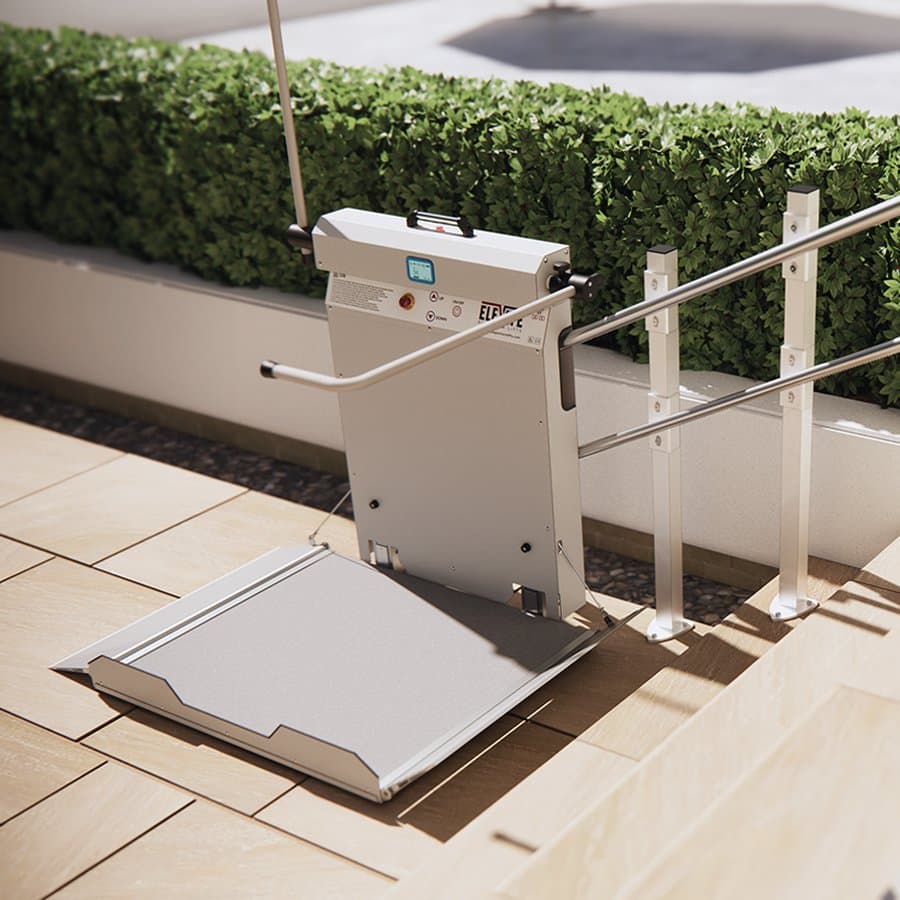
Incline platform lifts solve the staircase-only problem common in towers, galleries, and listed homes. The rail fixes to the staircase, the platform folds away between uses, and a bespoke rail can follow curves and half-landings. Fixing method is the consent-sensitive detail here: a good heritage installer will design fixings into mortar joints or later fabric rather than historic stone, and document the reversibility for the application. From £8,000 installed for straight staircases.
What conservation officers and DACs respond to is consistent: minimal intervention, reversibility, honest modern design rather than pastiche, and fixings that avoid historic fabric. Lift proposals presented with those four principles — and drawings showing them — pass far more smoothly than proposals presented as standard product installations.
Realistic costs and funding
Beyond the lift itself — from £6,389 for a step lift and £8,000 for a straight incline platform lift, with bespoke and storey-height installations priced per project — heritage projects should budget for the consent process: drawings, heritage statements, and possibly an architect or church architect's involvement. Churches have funding routes worth knowing: many dioceses point parishes to access-specific grant funds, the National Lottery Heritage Fund supports access improvements within wider projects, and charitable trusts focused on church repair frequently fund access works. VAT treatment varies — listed building work no longer enjoys zero-rating, but the Listed Places of Worship Grant Scheme can refund VAT on eligible works to listed churches, and disability-related supplies may qualify for VAT relief in their own right. Confirm specifics with the scheme and your accountant before budgeting.
A realistic project sequence
Survey and lift proposal first — you need drawings to apply for anything. Then pre-application advice (local authority) or DAC consultation (CofE), then the formal LBC or faculty application, then installation, which for most platform lifts takes days once consent is granted. End to end, allow several months, with the consent stage — not the installation — setting the pace. Installers in our network who work on heritage buildings can provide the drawings and supporting detail consent applications need. [ZAC — confirm heritage experience genuinely exists in your current network before publishing this sentence as-is.]
Get matched with a heritage-experienced installer
Tell us about the building, its listing status or denomination, and the level change. We will match you with vetted installers who understand consent-led projects — free, no obligation. For the wider compliance picture, see commercial platform lifts.
Get Free Advice → book a free quote
