Domestic Platform Lifts
A practical guide to domestic platform lifts: how they work, whether your home is suitable, what it's like to live with one, and how to buy well.
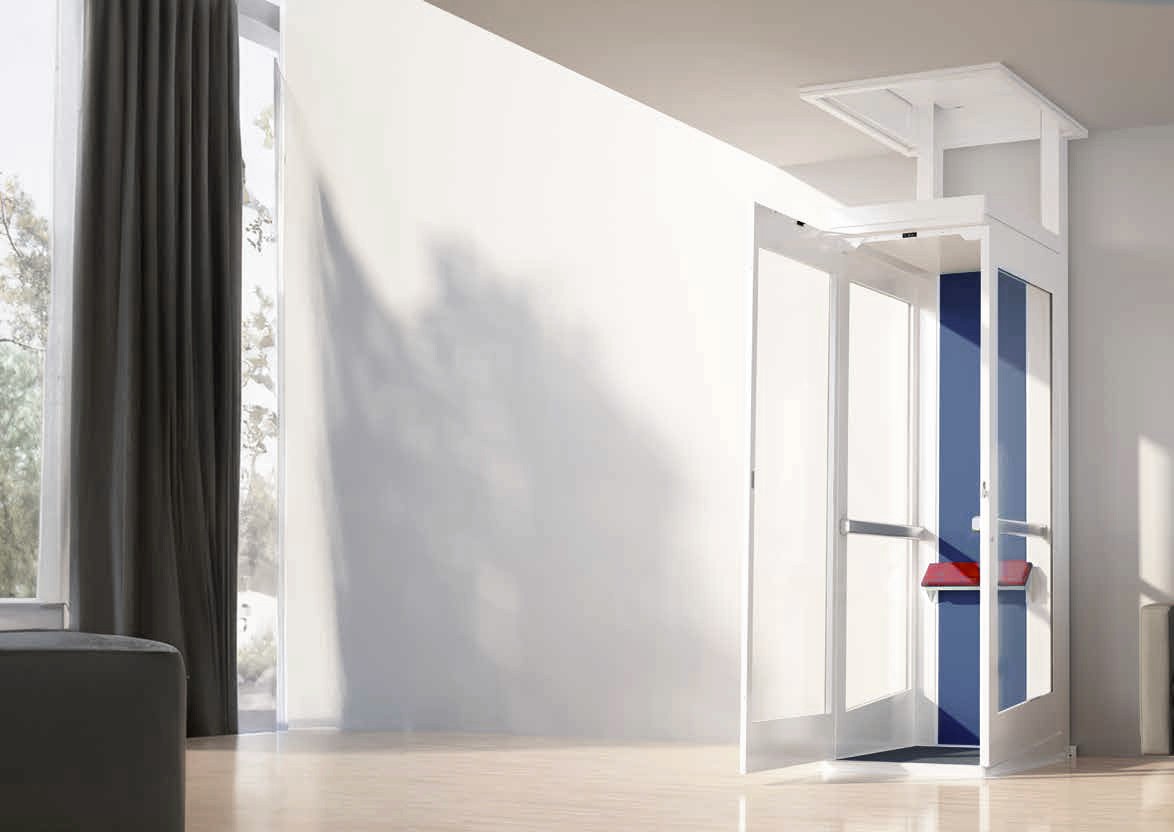
How a domestic platform lift works
A platform lift raises an open or enclosed platform slowly and under your control. That is the key difference from a passenger lift: it moves at a gentle pace, usually around 0.05–0.15 m/s, and most domestic models are hold-to-run — the lift moves only while you hold the button, and stops the instant you let go. That design is what keeps them safe and simple.
Most domestic platform lifts run on an ordinary single-phase 230V household supply, so you rarely need an electrical upgrade. They draw very little power because they spend almost all day idle, and they carry a battery back-up so a power cut leaves you able to complete a journey rather than stranded.
The drive is usually one of three types:
Screw and nut (leadscrew). Common on step lifts. Reliable, quiet, no hydraulics.
Traction or chain. Used on some through-floor and enclosed lifts.
Hydraulic. Smooth, used on some cabin lifts, needs a small power pack.
You do not need to memorise this, but it is worth asking which a quoted lift uses and why — a good installer will explain the trade-off for your situation.
The main types, briefly
There are four domestic platform lift types. This is the short version; the full comparison is here.
Type | Does what | Rough footprint |
|---|---|---|
Step lift | Clears steps and split levels, up to ~3 m | ~1.3 × 1.3 m |
Incline platform lift | Carries a wheelchair along the stairs | Rail plus folded platform |
Through-floor homelift | Travels between two storeys | ~1.1 × 1.5 m on both floors |
Enclosed platform lift | Closed cabin, low-rise, smart finish | Shaft plus base |
Structure note: first HTML embed.
Open platform or enclosed cabin?
This is the choice most people find genuinely useful to think through, because it affects cost, looks and comfort more than the drive type does.
Open platform | Enclosed cabin | |
|---|---|---|
Feel | Open, airy, you see out | Private, contained |
Weather | Fine indoors; needs care outdoors | Fully weatherproof |
Noise / draughts | More exposed | Quieter, sealed |
Cost | Lower | Higher |
Look in the home | Utilitarian | More like built-in furniture |
Best for | Short rises, budgets, outdoor steps | Prominent positions, between floors |
Neither is "better". An open step lift at a back door is the right call; an open platform in the middle of a hallway between two floors usually is not, and an enclosed cabin earns its extra cost there.
Is your home suitable?
Most of the time the lift is not the constraint — the house is. Before you fall for a particular model, check these.
Check | Why it matters | Watch out for |
|---|---|---|
Space on both levels | Through-floor lifts need the same footprint upstairs as down | The upstairs landing spot is often a bedroom already in use |
Floor strength | The lift and its load must be supported | Older joists may need trimming or a beam |
Headroom | The platform needs clearance at the top | Sloping ceilings and loft conversions |
Doorways and turning space | You must get on and off cleanly | Tight hallways force an awkward gate layout |
Power | A dedicated circuit is often needed | Old consumer units may need work |
Drainage (outdoor) | Standing water is the top cause of faults | Pits without drainage on outdoor step lifts |
If you are on the fence, an installer's survey is free and settles it quickly. It is far better to learn a through-floor lift won't fit the bedroom above before you have paid a deposit, not after.
What it costs, in short
Full detail is in the prices guide, but the starting points are:
Type | From (installed) |
|---|---|
Step lift | £6,389 |
Incline platform lift | £8,000 |
Enclosed platform lift | £10,000 |
Through-floor homelift | £17,500 |
Two things bring the real cost down at home. A Disabled Facilities Grant can contribute up to £30,000 in England (£36,000 Wales, £25,000 Northern Ireland; Scotland runs a separate scheme), and a lift for a disabled person in a private home can be zero-rated for VAT, taking 20% off. Our Disabled Facilities Grant guide covers how to apply.
Living with a domestic platform lift
The part the brochures skip. A few honest points from owners:
It is slow, and that is fine. A platform lift is not a hotel elevator. A single-storey trip takes the best part of a minute. You adjust within a week.
Servicing is a real cost. Budget for at least one service a year — more in a busy household. It covers the drive, safety edges and sensing plates, gate interlocks, emergency stop, battery back-up and controls. Skipping it is the most common reason lifts fail early.
Batteries are the main consumable. The back-up battery typically needs replacing every few years. It is a modest cost but not zero.
It changes the room. A through-floor lift is a permanent feature in two rooms. Plan where furniture goes around it, and consider the finish — an enclosed cab in a hallway is seen every day.
Resale is mixed. Some buyers value an installed lift; others see it as something to remove. A reversible, floor-mounted step lift is easier to take out than a through-floor installation.
If your lift was zero-rated for VAT, servicing on the same lift for the same person should be too — worth reminding your service provider.
Running costs at a glance
Cost | Typical | Notes |
|---|---|---|
Electricity | Minimal | Low-duty; idle most of the day |
Annual service | Budget a contract | Essential, not optional |
Battery back-up | Every few years | Main consumable |
Repairs | Occasional | Lower on well-serviced lifts |
Structure note: second HTML embed (or merge into the first — see note in the embed file).
Buying well: a short checklist
Get the survey first. A firm quote needs a site visit. Starting prices only narrow the field.
Get more than one quote. Prices and recommended types vary between installers.
Ask which standard the lift meets — EN 81-41 for vertical platform lifts, EN 81-40 for inclined.
Confirm VAT treatment in writing before you sign, if the user is disabled.
Start the grant early if you are applying — the DFG process takes months.
Check the service contract cost and what it covers, not just the purchase price.
Use vetted installers. Ask about credentials, references and warranty.
Platform Lift UK handles the last point for you: we match you with vetted installers who cover your area, free to you.
Get domestic platform lift quotes
FAQs (plain text)
What is a domestic platform lift? A domestic platform lift raises an open or enclosed platform slowly and under the user's control, to move a person — often a wheelchair user — over steps or between floors at home. It differs from a passenger lift in being slower and usually hold-to-run.
How much does a domestic platform lift cost? Starting prices are around £6,389 for a step lift, £8,000 for an incline platform lift, £10,000 for an enclosed platform lift and £17,500 for a through-floor homelift. Grants and VAT relief can reduce what you actually pay.
Do domestic platform lifts need special wiring? Usually not. Most run on a standard single-phase 230V household supply, though a dedicated circuit is often fitted. A three-phase upgrade is rarely needed. Older consumer units may need attention.
How much space does a domestic platform lift need? A step lift needs roughly 1.3 by 1.3 metres. A through-floor homelift needs around 1.1 by 1.5 metres on both floors, which is the constraint most homes hit first because the upstairs spot is often a bedroom.
How often do domestic platform lifts need servicing? At least once a year, and more in a busy household. Servicing covers the drive, safety devices, gate interlocks, emergency stop and battery back-up. Regular servicing is the main thing that prevents early faults.
What happens in a power cut? Domestic platform lifts carry a battery back-up that lets you complete a journey during a power cut rather than being stranded. The back-up battery is a consumable that typically needs replacing every few years.
Can a domestic platform lift be removed later? Yes, though it varies by type. A floor-mounted step lift is relatively straightforward to remove and relocate. A through-floor homelift is a permanent installation, and taking it out means making good the floor opening.
