How to Choose the Right Platform Lift for Your Home: A Beginner's Guide
Not sure which home platform lift is right for your property? This beginner's guide explains the key differences between platform lifts, wheelchair lifts, and homelifts — helping you make the right choice first time.
What Is a Platform Lift?
A home platform lift is a broad term used to describe any lift that carries a person on an open or enclosed platform between levels of a building. Unlike a traditional passenger lift found in commercial buildings, platform lifts are designed specifically for domestic and light commercial use, operate at lower speeds, and typically require less structural work to install.
Platform lifts are used in homes to solve a wide variety of access problems — from navigating one or two entrance steps to reaching an upper floor without using the stairs. The right type of platform lift depends on what problem you are trying to solve, how much space you have available, and whether the primary user is a wheelchair user or someone who can stand but struggles with stairs.
Understanding the Different Types of Home Platform Lift
Through-Floor Homelifts
A through-floor homelift — sometimes called a residential lift or domestic lift — travels vertically between two floors of a property by passing through an opening cut into the ceiling and floor above. These are enclosed lifts with a cabin large enough to stand in, and they offer the most comfortable and conventional lift experience available for domestic use.
Through-floor homelifts are ideal for homeowners who want a permanent, discreet solution that does not dominate the aesthetics of their home. Modern homelifts are available in a wide range of finishes and can be specified with glass panels, soft-close doors, and custom interior colours to complement the design of your home.
They typically require a footprint of around 0.8m x 1.0m to 1.2m x 1.4m depending on the model and manufacturer, and a minimum floor-to-ceiling height of around 2.2 metres. No machine room or pit is required for most modern homelift designs, which makes them significantly easier to install in existing domestic properties than traditional lifts.
Vertical Platform Step Lifts
A vertical platform step lift is a low-rise platform lift designed specifically to overcome one to three steps at an entrance, threshold, or level change within a property. Unlike a full homelift, a step lift does not travel between floors — it typically rises between 300mm and 2,000mm, making it ideal for situations where stairs have become a barrier but a full staircase is not involved.
Step lifts are widely used at front or rear entrance steps, split-level properties, and internal level changes such as a sunken living room. They can be installed both indoors and outdoors, and outdoor models are specifically designed to withstand the UK climate.
A vertical platform step lift is one of the most cost-effective access solutions available, with prices typically starting from around £6,389. Installation is usually straightforward and can often be completed in a single day.
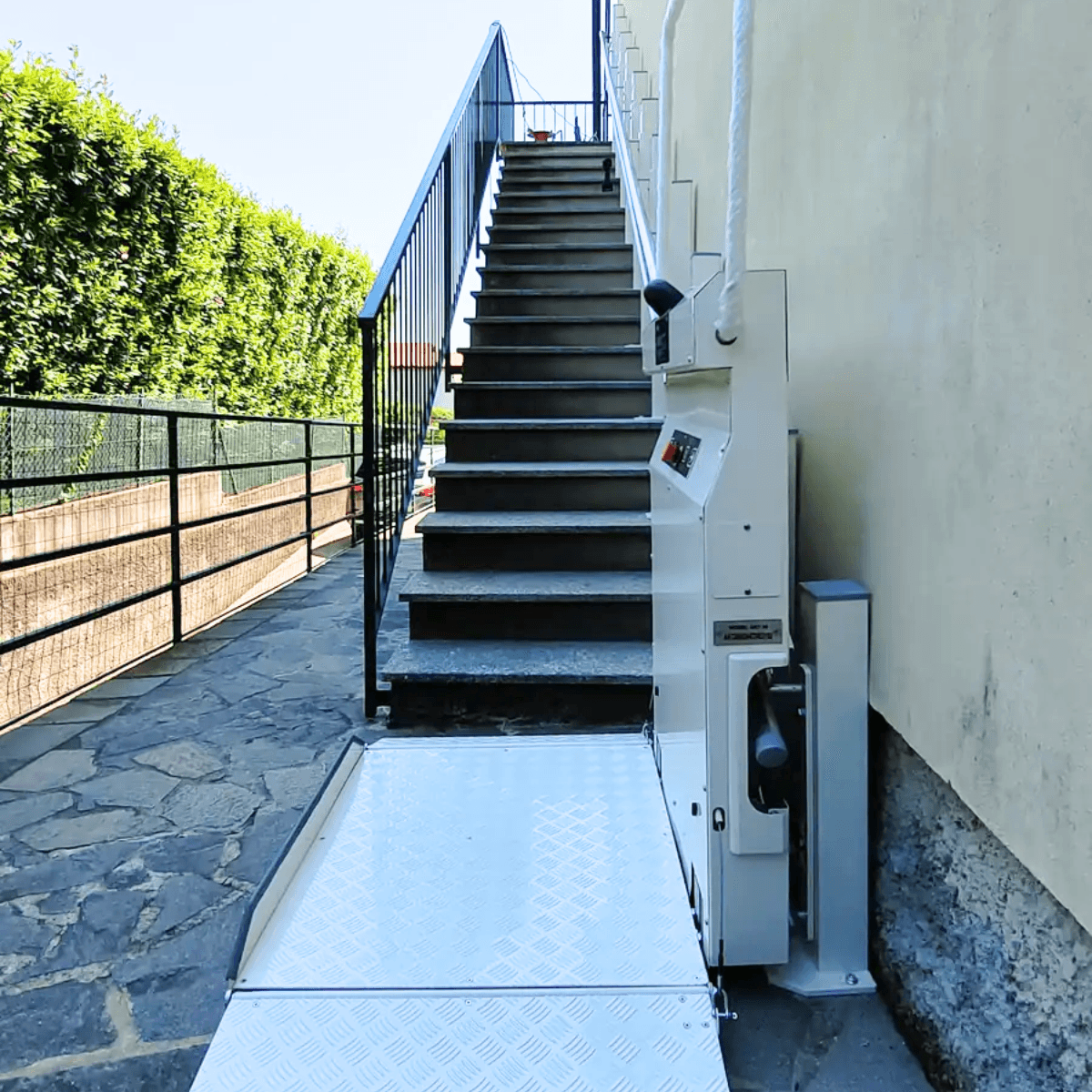
Incline Platform Stairlifts
An incline platform lift — also known as a platform stairlift — is a wheelchair lift that travels along a rail fixed to the staircase, carrying the user and their wheelchair up and down the stairs without requiring them to transfer out of their chair. This distinguishes it from a conventional stairlift, which requires the user to sit on a small seat and cannot accommodate a wheelchair.
Incline platform lifts are available for straight staircases and, in some cases, for curved staircases. The platform folds flat when not in use to keep the staircase accessible to other household members. They are an important Equality Act compliance solution in commercial settings and are increasingly used in residential properties where a through-floor homelift is not practical or where the user requires wheelchair access on the stairs.
What Is a Wheelchair Lift?
The term wheelchair lift is often used interchangeably with platform lift, but it specifically refers to any lift that is designed to carry a person while seated in their wheelchair. This includes vertical platform step lifts, incline platform stairlifts, and some through-floor homelifts with cabins wide enough to accommodate a standard wheelchair.
When choosing a wheelchair lift for home use, the key specification to check is the internal platform dimensions. A standard manual wheelchair requires a clear width of approximately 700mm to 800mm, while a powered wheelchair or scooter may require significantly more space. Always confirm the dimensions of the wheelchair or mobility device that will be using the lift before specifying a model.
Key Questions to Ask Before Choosing a Home Platform Lift
What access problem are you trying to solve? Is the issue one or two entrance steps, a full staircase, or access between floors? The answer to this question largely determines which lift type is appropriate. Step lifts solve small level changes. Incline platform lifts solve staircase access for wheelchair users. Through-floor homelifts solve floor-to-floor access.
Will the primary user be standing or seated in a wheelchair? If the primary user is a wheelchair user, the lift must be specified accordingly. Ensure the platform or cabin dimensions are sufficient for the specific wheelchair or mobility device in use. If the user can stand but struggles with stairs, a wider range of options are available.
How much space is available? Space is often the deciding factor between lift types. Through-floor homelifts require a consistent footprint on both the ground and upper floor. Incline platform stairlifts require a staircase wide enough to accommodate the folded platform. Step lifts require a level area at both the top and bottom of the steps.
Is the installation indoor or outdoor? Not all platform lifts are rated for outdoor use. If you need a step lift or platform lift at an external entrance, ensure the model you are considering is specifically designed for outdoor installation and carries appropriate weatherproofing certification.
What is your budget? Home platform lifts range from around £6,389 for a basic step lift to £35,000 or more for a fully specified through-floor homelift. Understanding your budget early helps narrow down the options. It is also worth exploring the Disabled Facilities Grant before committing to any purchase, as eligible applicants may be able to fund all or a significant portion of the cost through their local authority.
Does the property require any structural modifications? Through-floor homelifts require an opening to be created between floors, which involves structural work and may require building regulations approval. Step lifts and incline platform stairlifts typically require minimal structural alteration. Your installation company should carry out a survey and advise on what is required for your specific property.
Planning Permission and Building Regulations
In most cases, installing a platform lift within a domestic property does not require planning permission, as it falls under permitted development. However, if you live in a listed building or a property within a conservation area, you may need to obtain listed building consent or consult your local planning authority before proceeding.
Building regulations approval is generally required for through-floor homelifts, as the installation involves creating a structural opening between floors. Most reputable lift installation companies will manage the building regulations process on your behalf as part of the installation service.
How to Get the Right Advice
The best starting point when choosing a home platform lift is an occupational therapist assessment. An OT can assess your mobility needs, recommend the most appropriate type of lift, and provide a supporting report that may be needed for a Disabled Facilities Grant application. Your GP can refer you to an OT through the NHS, or you can access one privately.
Once you have a clearer picture of which lift type is appropriate, getting quotes from multiple vetted installation companies is strongly recommended. Prices, lead times, product quality, and aftercare vary significantly between companies, and comparing at least two or three quotes will help you make a well-informed decision.
Platform Lift UK is a free, independent matching service that connects homeowners and businesses across the UK with vetted platform lift installation companies. We cover all lift types — step lifts, through-floor homelifts, incline platform stairlifts — and our service carries no obligation to proceed. Simply tell us about your property and requirements and we will match you with the right specialists for your situation.
Click here for our article on Wheelchair lifts for residential & commercial properties
