Dumbwaiter Lifts in 2026: Technology, Trends and Installation Guide
Dumbwaiter lifts have evolved significantly in recent years. This guide covers the latest technology, design trends for 2026, typical installation requirements, and everything you need to know before specifying a dumb waiter lift for your home or business.
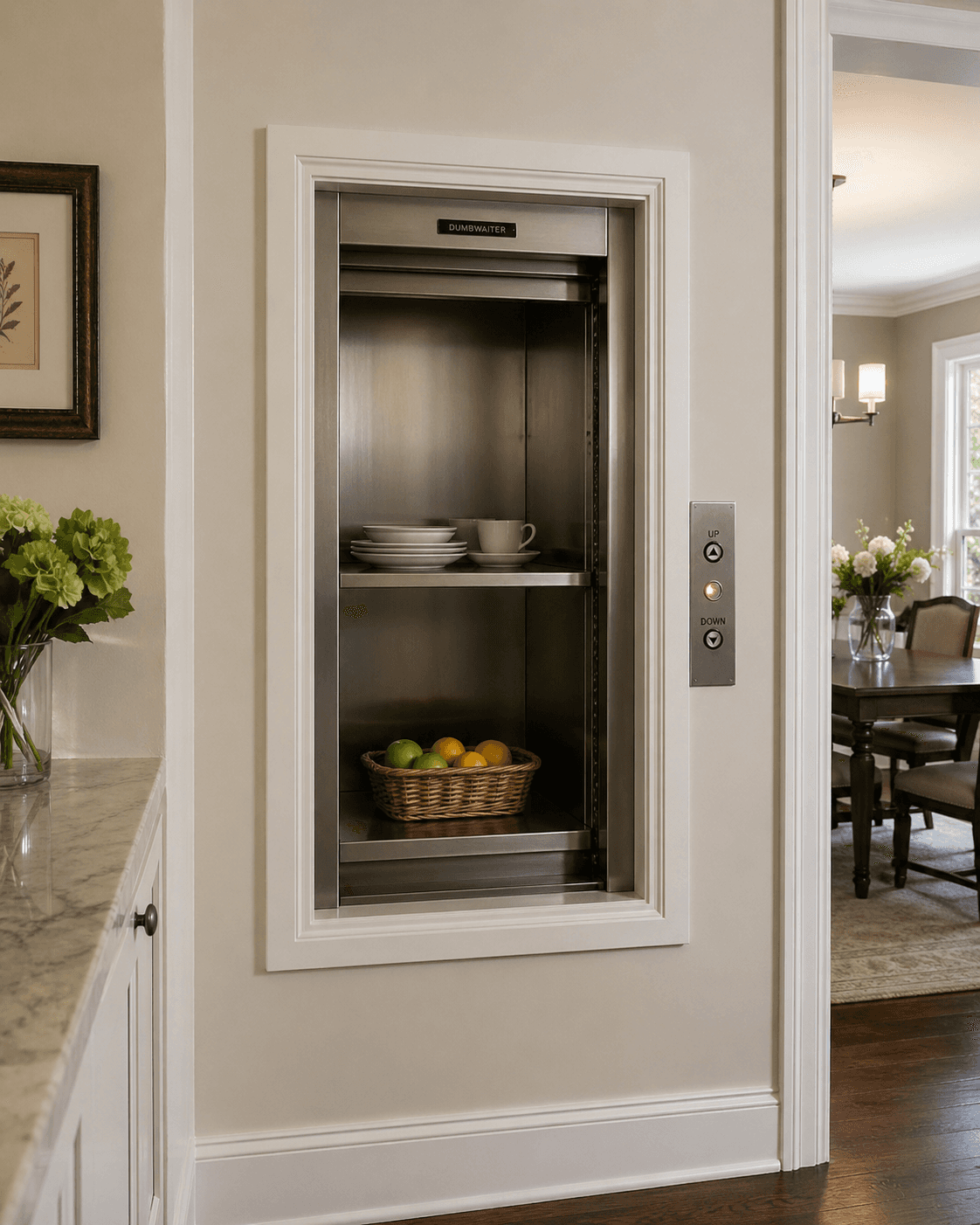
What Is a Dumbwaiter Lift?
A dumbwaiter lift is a small goods-only lift designed to carry items — food, laundry, files, stock, medical supplies, or any other cargo — between floors of a building without requiring a person to carry them. Unlike a passenger lift, a dumbwaiter is not designed or certified to carry people, and its platform or cabin dimensions are sized accordingly.
The name derives from the eighteenth century, when a mechanical shelf device of the same name was used in dining rooms to allow servants to leave the room while still making food and drink accessible to guests. The powered through-floor dumbwaiter lift as we know it today became common in commercial kitchens and hotels during the twentieth century and has since evolved into a product category that serves a remarkably wide range of applications.
In residential settings, dumbwaiter lifts are increasingly used in multi-storey homes to move groceries, laundry, and household items between floors — reducing the physical strain of carrying loads on staircases and improving convenience for all household members, not just those with mobility limitations. In commercial settings, they are an essential operational tool in restaurants, care homes, libraries, retail stockrooms, and office buildings.
How Dumbwaiter Lift Technology Has Evolved in 2026
The most significant technological developments in dumbwaiter lifts over recent years have been in drive systems, control interfaces, and noise reduction.
Drive Systems
Early dumbwaiter lifts used drum-and-cable systems that were functional but relatively noisy and required regular maintenance. Contemporary dumb waiter lifts increasingly use traction drive systems with counterweights, which offer smoother operation, lower energy consumption, and longer service intervals. Some manufacturers now offer hydraulic dumbwaiters for heavier load applications, while others have developed rack-and-pinion systems that eliminate the need for a counterweight and reduce the required shaft dimensions.
Battery backup systems — which allow the lift to complete its current journey in the event of a power cut — are now standard on many commercial-grade dumbwaiter models and are becoming increasingly common in residential products.
Control Systems
Control interfaces have moved on considerably. Older dumbwaiters used simple call-and-send buttons with limited functionality. Modern dumbwaiter lift control systems offer multi-floor calling from any landing, digital displays showing the current position of the cabin, programmable door-open times, and in some commercial models, integration with building management systems. Touchscreen panels and app-based controls are beginning to appear at the higher end of the market, though these remain more common in bespoke commercial installations than in off-the-shelf residential products.
Noise Reduction
Noise has historically been a limitation of dumbwaiter lifts in residential settings. The mechanical noise of motors, cables, and counterweights travelling through a building can be intrusive, particularly in open-plan homes or properties with lightweight floor structures. In 2026, leading manufacturers have addressed this through the use of vibration-damping motor mounts, noise-insulated shaft linings, and soft-start motor controllers that eliminate the sudden jolt of a conventional motor starting at full speed. The result is a dumbwaiter lift that is genuinely unobtrusive in everyday residential use.
Cabinetry and Finish
The landing door and surround design of residential dumbwaiter lifts has improved significantly. Where older products offered little choice beyond a standard stainless steel hatch, contemporary manufacturers offer a range of finishes including powder-coated panels, timber-effect surrounds, and bespoke joinery integration that allows the landing door to be designed to match existing cabinetry or fitted furniture. This is particularly relevant for high-end residential projects where the dumbwaiter needs to be visually integrated rather than visually prominent.
Types of Dumbwaiter Lift
Residential Dumbwaiter Lifts
Residential dumb waiter lifts are compact, relatively lightweight, and designed for installation within the fabric of an existing home. They typically have a load capacity of between 25kg and 100kg, a cabin volume of between 0.1 and 0.5 cubic metres, and travel between two or three floors. They are available as self-contained units that can be retrofitted into an existing home without major structural work, making them suitable for installation during a renovation or even as a standalone project.
Commercial Dumbwaiter Lifts
Commercial dumbwaiter lifts are specified for heavier loads, higher cycle frequencies, and more demanding operational environments. Load capacities typically range from 100kg to 300kg or more, and commercial models are built to withstand the continuous use of a working kitchen, care home, or multi-storey retail environment. Commercial dumbwaiters are usually installed as part of a new build or major refurbishment project and require a dedicated shaft constructed as part of the building works.
Counter-Level Dumbwaiters
A counter-level dumbwaiter — sometimes called a pass-through lift or service lift — is a compact unit designed to deliver items directly to a counter or worktop height at the upper landing rather than to floor level. These are particularly popular in restaurants and food service environments where kitchen staff need to transfer plated dishes directly to a service station without bending or lifting.
Installation Requirements for Dumbwaiter Lifts
Shaft and Structural Requirements
A dumbwaiter lift requires a vertical shaft to travel through. In new build projects, the shaft is typically constructed from blockwork, timber studwork, or a proprietary enclosure system. In existing buildings, retrofitting a dumbwaiter lift requires either finding an existing void — such as a cupboard stack aligned on successive floors — or constructing a new shaft, which involves structural work and may affect floor joists.
The minimum shaft dimensions vary between manufacturers and models, but a typical residential dumbwaiter requires a shaft of approximately 600mm x 600mm in plan, with clear height requirements at each landing for the door and control panel. Your installation company should carry out a detailed survey of the property before specifying a shaft design.
Power Supply
Most residential dumbwaiter lifts run on a standard 240V single-phase domestic power supply, which means no specialist electrical installation is required beyond a dedicated spur from the consumer unit. Commercial models with larger motors may require a three-phase supply, which should be confirmed at the survey stage.
Building Regulations
In England and Wales, the installation of a dumbwaiter lift in a domestic property is subject to Building Regulations notification, primarily in relation to the structural work involved in creating or modifying the shaft. The lift unit itself is generally subject to the supply of machinery regulations rather than the Lift Regulations, which apply to passenger lifts. A reputable installation company will advise on and manage the regulatory notification process as part of the installation.
Maintenance and Servicing
Dumbwaiter lifts require periodic maintenance to remain safe and reliable. Most manufacturers recommend a service interval of six to twelve months, with the frequency depending on the load capacity, cycle frequency, and age of the unit. A maintenance contract with a qualified lift engineer is strongly recommended and may be required by your insurance provider for commercial installations.
## Dumbwaiter Lift Sizes and Dimensions
One of the most common questions about dumbwaiter lifts is what size is available and which size is right for a specific application. Dumbwaiter dimensions vary significantly between residential and commercial products, and choosing the wrong size is one of the most avoidable installation mistakes.
### Residential Dumbwaiter Sizes
Residential dumbwaiters are compact by design. Typical platform dimensions for a domestic dumbwaiter range from:
- Small — approximately 450mm x 450mm x 450mm internal, suitable for bottles, light household items
- Medium — approximately 600mm x 600mm x 600mm internal, suitable for grocery bags, laundry
- Large — approximately 750mm x 750mm x 750mm internal, suitable for larger loads including small furniture items or catering trays
Load capacities for residential dumbwaiters typically range from 25kg to 100kg. Always specify the intended use when requesting a quote — the heaviest single load you are likely to carry determines the required capacity.
### Commercial Dumbwaiter Sizes
Commercial dumbwaiters for restaurants, hotels, and care homes are considerably larger. Common sizes include:
- Standard commercial — approximately 700mm x 800mm x 800mm internal
- Large commercial — approximately 900mm x 900mm x 1,000mm internal
- Heavy duty — up to 1,200mm x 1,000mm x 1,000mm internal or larger for bespoke installations
Commercial dumbwaiters typically carry between 100kg and 300kg per journey. The correct size depends on the maximum tray or trolley dimensions and the heaviest load the lift will need to carry during service.
---
How Much Does a Dumbwaiter Lift Cost in the UK?
Dumbwaiter lift cost is one of the most searched questions on this topic and one of the most difficult to answer accurately without a site survey — because cost depends heavily on the specific installation.
As a general guide for 2026:
- **Residential dumbwaiter, two floors, straightforward installation** — from approximately £8,000 to £12,000 installed, including the unit, shaft lining, landing doors, and electrical connection
- **Residential dumbwaiter, three floors** — from approximately £12,000 to £18,000, with the additional cost reflecting the extended shaft and additional landing door
- **Commercial dumbwaiter, two floors, new build** — from approximately £15,000 to £25,000 installed
- **Commercial dumbwaiter, heavy duty or bespoke** — £25,000 or more depending on specification
These are indicative starting figures. The most significant variables affecting the final cost are:
- Whether an existing shaft void is available or a new shaft needs to be constructed
- The number of floors served
- The load capacity required
- The finish and aesthetic specification of the landing doors and surround
- The complexity of the electrical supply required
VAT is charged at the standard rate on commercial dumbwaiter installations. For residential dumbwaiters installed to assist a disabled person, reduced rate VAT may apply — confirm this with your installer.
Dumbwaiter Lift Maintenance and Servicing
All dumbwaiter lifts require periodic maintenance to remain safe and reliable. Maintenance requirements vary between manufacturers and drive systems, but as a general guide:
- Residential dumbwaiters typically require a service every 6 to 12 months
- Commercial dumbwaiters used in high-cycle environments such as busy restaurant kitchens typically require quarterly servicing
- Most manufacturers recommend an annual safety inspection in addition to routine servicing
A maintenance contract with a qualified lift engineer is strongly recommended. For commercial installations, some insurance policies require evidence of regular servicing as a condition of cover. Check your policy before assuming servicing is optional.
The main components that require periodic attention are:
- Drive motor and gearbox — lubrication and wear checks
- Safety devices — overspeed governor and buffer testing
- Landing doors — alignment, seals, and lock mechanisms
- Control system — button function and door interlock operation
- Ropes or chains — tension and wear assessment
---
Dumbwaiter Lifts for Restaurants and Commercial Kitchens
The restaurant and commercial kitchen market is one of the largest application areas for dumbwaiter lifts in the UK. In a multi-storey restaurant or hotel, a dumbwaiter eliminates the need for staff to carry food, equipment, and supplies up and down stairs between kitchen and service floors — reducing physical strain, improving speed of service, and reducing the risk of accidents.
Key considerations for restaurant dumbwaiter installations:
- **Platform size** — must accommodate the largest tray format or trolley used in service. For à la carte restaurants serving full plates, a minimum of 700mm x 700mm is usually recommended
- **Load capacity** — must cover the maximum weight of a fully loaded tray or trolley
- **Speed** — commercial dumbwaiters operate at speeds of 0.15 to 0.4 metres per second; for busy service periods, the faster end of this range is preferable
- **Number of landings** — multi-floor restaurants may need the dumbwaiter to serve three or more floors
- **Counter height** — a counter-level dumbwaiter that delivers to worktop height at the service station reduces lifting by staff and speeds up plating
- **Hygiene and finish** — stainless steel interiors are standard for food service environments
- **Noise** — during service periods, a quiet drive system reduces interference with the dining experience
Dumbwaiter Lifts for Care Homes
Care homes represent another major application area for dumbwaiters, where they are used to move meals, laundry, medical supplies, and equipment between floors without putting physical strain on care staff.
For care home applications, specific considerations include:
- Load capacity sufficient for a fully loaded meal trolley — typically 100kg to 150kg
- Platform dimensions to accommodate care home tray formats
- Simple, intuitive controls that can be operated by all members of staff
- Minimal maintenance requirements to reduce operational disruption
- Integration with fire safety systems — the dumbwaiter must fail safe in a fire situation
Manual Dumbwaiter Systems
Not all dumbwaiters are powered. Manual dumbwaiter systems — operated by a pulley and rope mechanism — are still available and can be appropriate for low-frequency use in properties where a power supply to the shaft location is not practical.
Manual dumbwaiters are significantly lower cost than powered units, with prices starting from around £1,500 to £3,000 for a basic installation. However, they require physical effort to operate, have much lower load capacities (typically 15kg to 25kg), and are not suitable for commercial environments or for elderly or mobility-impaired users.
For most residential and all commercial applications, a powered dumbwaiter is the more practical choice.
What Does a Dumbwaiter Lift Cost in the UK?
The cost of a dumbwaiter lift installation in the UK varies considerably depending on the type of unit, the number of floors served, the complexity of the shaft construction, and the level of finish required.
For a basic residential dumbwaiter serving two floors in an existing property with a suitable void or cupboard stack available, installation costs typically start from around £8,000 to £12,000 including the unit, shaft lining, landing doors, and electrical connection. Where significant structural work is required to create a new shaft, costs will be higher.
Commercial dumbwaiter installations in restaurants, care homes, or office buildings typically start from £15,000 and can rise significantly for bespoke or heavy-duty specifications.
As with any lift installation, getting multiple quotes from vetted companies is strongly recommended. Platform Lift UK can connect you with specialist dumbwaiter lift installation companies across the UK through our free matching service — simply describe your project and we will identify the right companies for your building and requirements.
