Commercial Accessibility Compliance: Beyond the Equality Act for Public Buildings
Understanding your legal obligations around commercial accessibility goes further than most building owners realise. This guide covers the Equality Act, Building Regulations, and the practical steps public buildings need to take — including when a platform lift is the right solution.
The Equality Act 2010: What It Actually Requires
The Equality Act 2010 places a legal duty on service providers, employers, and those responsible for public buildings to make reasonable adjustments to ensure that disabled people are not placed at a substantial disadvantage compared to non-disabled people. This duty is anticipatory — meaning you are not required to wait until a disabled person encounters a problem before acting. You are expected to think ahead and put reasonable adjustments in place proactively.
The term reasonable adjustment is deliberately flexible. What is reasonable for a large organisation with significant resources will differ from what is reasonable for a small independent business. Factors that courts and tribunals consider when assessing reasonableness include the cost of the adjustment, the practicality of making it, the resources available to the organisation, and the extent to which it would actually overcome the disadvantage faced by disabled people.
Importantly, the Equality Act does not provide a definitive list of adjustments that must be made. This gives building owners some flexibility but also creates uncertainty. The practical consequence is that if a disabled person cannot access a service or facility that a non-disabled person can access, you are potentially in breach of the Act — and the burden of proof lies with you to demonstrate that any alternative provision is genuinely equivalent.
What the Equality Act Does Not Do
A common misconception is that the Equality Act sets specific technical standards for building accessibility. It does not. The Act sets out the legal duty but does not specify how it must be met. Technical standards for access — minimum door widths, ramp gradients, lift dimensions, signage specifications — are set out separately in Building Regulations and the associated technical guidance documents.
This distinction matters because compliance with Building Regulations alone does not guarantee compliance with the Equality Act, and vice versa. A building that was constructed to the Building Regulations in force at the time it was built may still fall short of what is now considered a reasonable adjustment under the Equality Act, particularly as standards and expectations have evolved.
Part M of the Building Regulations: Access to and Use of Buildings
Part M of the Building Regulations applies to new buildings and to material alterations and changes of use of existing buildings. It sets out the technical requirements that must be met to achieve accessible and inclusive design, and is supported by Approved Document M, which provides detailed technical guidance on how the requirements can be satisfied.
Part M is divided into two volumes. Volume 1 covers dwellings and sets out three categories of accessibility standard for new homes. Volume 2 covers buildings other than dwellings and is the relevant document for commercial and public buildings.
For commercial buildings, Part M requires that disabled people are able to reach the principal entrance of the building, gain access into and within the building, use the facilities provided, and make use of sanitary accommodation. Where a building has multiple storeys, access between floors is a key requirement — and a platform lift or passenger lift is frequently the most appropriate way to achieve this, particularly in existing buildings where structural constraints make other solutions impractical.
Approved Document M and Platform Lifts
Approved Document M provides specific technical guidance on lifting devices for buildings other than dwellings. It distinguishes between different lift types and sets out minimum cabin dimensions, door widths, call button heights, and other specifications that must be met for a lift installation to satisfy the Building Regulations.
For a platform lift to comply with Approved Document M, the lift must meet the requirements of BS EN 81-41, the British and European standard for vertical lifting platforms intended for use by people with impaired mobility. Key requirements include a minimum platform size of 900mm x 1,400mm for a lift that needs to accommodate a wheelchair user, clear door opening widths of at least 800mm, and controls positioned at heights accessible from a seated position.
Not all platform lifts on the market are certified to BS EN 81-41, so it is important to confirm certification when specifying a lift for a commercial building where regulatory compliance is required.
The Public Sector Equality Duty
Public authorities — which include central and local government bodies, NHS organisations, schools, further and higher education institutions, and other bodies exercising public functions — are subject to an additional obligation known as the Public Sector Equality Duty (PSED) under Section 149 of the Equality Act.
The PSED requires public authorities to have due regard to the need to eliminate discrimination, advance equality of opportunity, and foster good relations between people with different characteristics. In practical terms this means public sector organisations are expected to actively consider accessibility in all their decision-making, not simply react to complaints. For facilities managers and estates teams in the public sector, this means accessibility compliance should be built into capital planning, refurbishment projects, and procurement processes from the outset.
Historic and Listed Buildings
One of the most frequently cited challenges in commercial accessibility compliance is the tension between accessibility requirements and the constraints of historic or listed buildings. Planning and listed building consent requirements can restrict the types of physical alteration that are permissible, which can make it difficult to install conventional access solutions.
However, listed building status does not exempt a property from the duty to make reasonable adjustments under the Equality Act. The expectation is that building owners and managers explore every available option within the constraints of planning consent, and that they demonstrate they have done so. In many cases, a compact platform lift — particularly a vertical platform step lift or a through-floor homelift with a minimal structural footprint — can provide compliant step-free access without the level of structural intervention that would be refused under listed building consent.
Where a physical alteration is genuinely not possible due to planning restrictions, the Equality Act requires that the service be provided by an alternative means — for example, by offering the service on a ground floor accessible to all, or by making alternative arrangements. However, this alternative provision must be genuinely equivalent and must not require a disabled person to accept a materially inferior service.
Fire Safety and Emergency Evacuation
Accessibility compliance does not end when a disabled person reaches their destination within the building. Fire safety legislation — principally the Regulatory Reform (Fire Safety) Order 2005 in England and Wales — requires building owners and responsible persons to ensure that all occupants, including disabled people, can evacuate safely in an emergency.
Standard platform lifts and passenger lifts must not be used for evacuation in a fire, as they may fail in a fire situation and could trap occupants. The appropriate solution is the provision of refuge areas — protected spaces where a disabled person can wait safely for assistance — combined with a Personal Emergency Evacuation Plan (PEEP) for disabled employees and visitors.
Some buildings install evacuation chairs or evacuation lifts that are specifically designed and certified for use during a fire evacuation. Where these are installed, staff training is essential. The fire risk assessment for any building must specifically address the needs of disabled occupants, and this should be reviewed whenever a significant change is made to the building or its use.
British Standard BS 8300: Design of an Accessible and Inclusive Built Environment
BS 8300 is the British Standard that provides comprehensive guidance on the design of accessible and inclusive buildings. While it is not a legal requirement in the same way that Building Regulations are, it is widely used as a benchmark for best practice and is referenced in planning guidance, procurement specifications, and access audits.
BS 8300 covers a significantly wider range of design considerations than Approved Document M, including acoustic environments, lighting levels, wayfinding and signage, and the needs of people with sensory and cognitive impairments as well as those with physical mobility limitations. Compliance with BS 8300 is increasingly expected by local planning authorities as part of the planning process for new commercial developments, and many public sector clients require compliance as a contractual condition.
The Role of an Access Audit
An access audit is a systematic assessment of a building carried out by a qualified access consultant to identify barriers to access and recommend solutions. It is not a legal requirement, but it is one of the most effective ways for a building owner or manager to understand their current compliance position and prioritise remedial works.
A good access audit will assess the building against the requirements of the Equality Act, Part M of the Building Regulations, and BS 8300, and will produce a prioritised schedule of works that distinguishes between immediate compliance risks and longer-term improvement recommendations. For a building that has never been audited, this is often the best starting point before commissioning any access improvement works.
Access audits should be carried out by a registered member of the National Register of Access Consultants (NRAC). The NRAC maintains a publicly searchable directory of qualified consultants.
When a Platform Lift Is the Right Compliance Solution
For commercial and public buildings where stepped access between levels creates a barrier for wheelchair users or people with mobility impairments, a platform lift is frequently the most practical and cost-effective compliance solution. This is particularly true in existing buildings where the structural and spatial constraints make installing a full passenger lift impractical or prohibitively expensive.
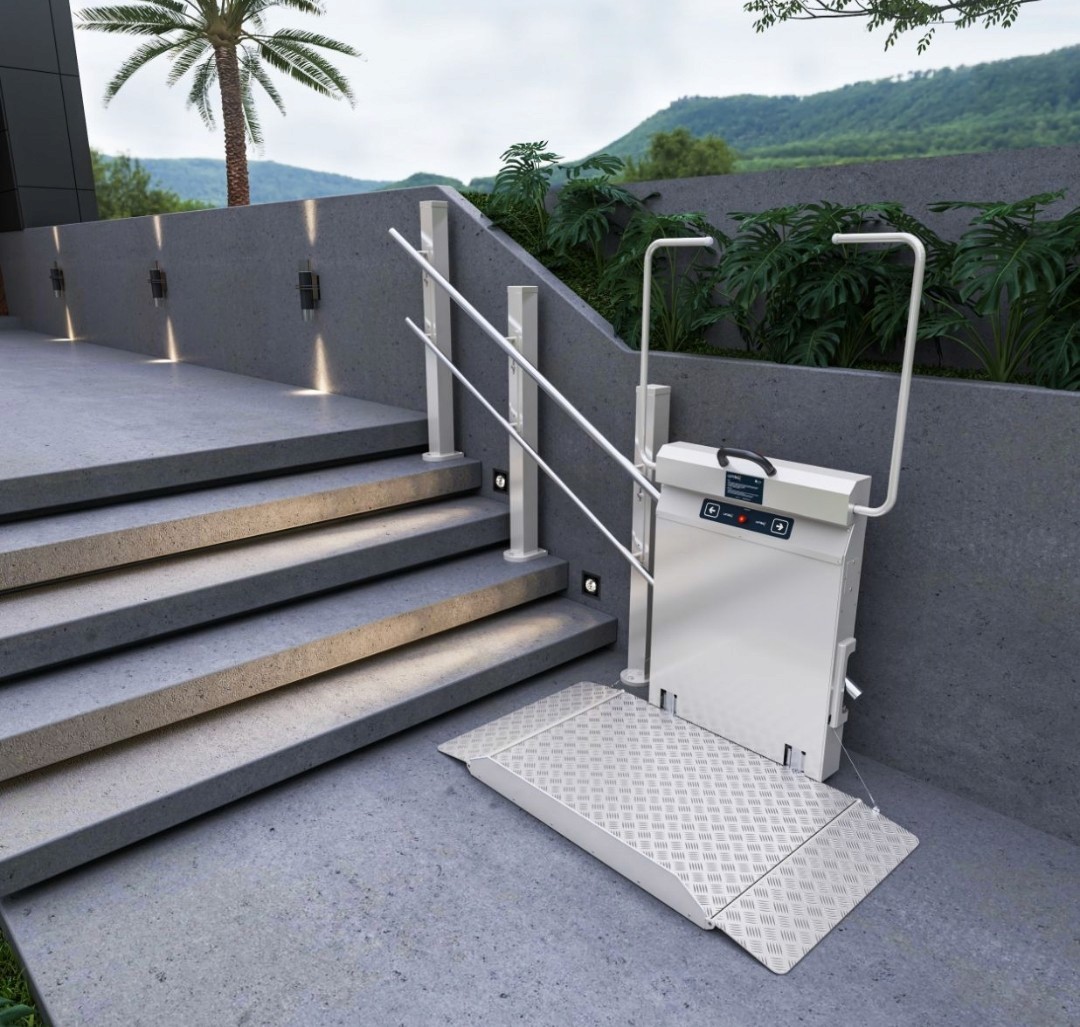
Platform lifts for commercial use are available in vertical and incline configurations. A vertical platform lift provides direct floor-to-floor access and can be installed with a relatively small footprint. An incline platform stairlift provides access along an existing staircase for wheelchair users without requiring structural alteration to the building fabric.
When specifying a platform lift for commercial compliance purposes, the key considerations are certification to BS EN 81-41, compliance with the dimensional requirements of Approved Document M, finish and aesthetics appropriate to the building, maintenance and servicing arrangements, and compatibility with the building's existing electrical supply.
Platform Lift UK works with a network of vetted commercial lift installation companies across England, Wales, and Scotland. Our free matching service connects building owners, facilities managers, architects, and project managers with the right specialists for their project — whether that is a straightforward vertical step lift at an entrance or a more complex multi-floor commercial platform lift installation. Contact us to discuss your requirements and we will match you with the appropriate companies for your building.
