
Home Lifts UK — The Complete Guide for Homeowners
Everything you need to know about home lifts in the UK — how they work, what types are available, what they cost, and how to find a vetted installer. Free independent advice from Platform Lift UK.
What is a Home Lift?
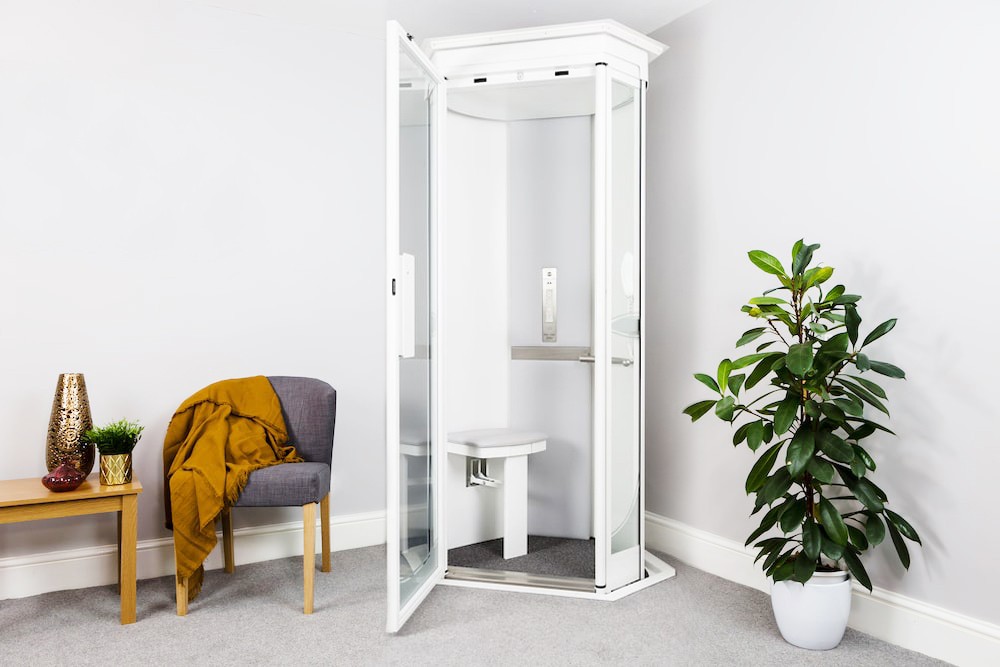
A home lift — also known as a domestic lift, through-floor lift, or residential lift — is a lift installed within a private dwelling to provide access between two or more floors. Unlike a stairlift, which carries a user along the staircase, a home lift travels vertically through the floor — rising from one level to the next through an opening created in the ceiling and floor above.
Home lifts are used for a wide range of reasons. Some homeowners install them as an accessibility aid — to allow a family member who uses a wheelchair or has limited mobility to access upper floors independently. Others install them as a long-term investment in their property — future-proofing their home against the need for mobility adaptations in later life. Increasingly, home lifts are also installed as a premium lifestyle feature in new-build and renovated properties, where they add both convenience and value.
Modern home lifts do not require a lift shaft, a pit, or significant structural alterations. Most can be installed in two days with minimal disruption to the household.
Types of Home Lift Available in the UK
Several distinct types of home lift are available in the UK market. The right type for your property depends on your available floor space, ceiling height, budget, and intended use.
Through-floor open platform lifts are the most compact and affordable type of home lift. The platform is open — typically with a folding guard rail rather than an enclosed cabin — and travels through an opening in the ceiling to the floor above. These lifts have the smallest footprint of any home lift type and can be installed almost anywhere in a home, including in a living room, hallway, bedroom, or garage. They are suitable for wheelchair users and those who prefer to travel seated on a fold-down seat. Costs typically start from around £8,000 to £15,000 installed.
Fully enclosed through-floor home lifts are similar in principle to open platform lifts but feature a full cabin enclosure with a door — providing a more private and more conventional lift experience. The cabin rises through the floor with the door sealing the opening at each level, maintaining fire and smoke separation between floors. These lifts are suitable for wheelchair users, standing users, and those who want a more enclosed travelling environment. Costs typically start from around £12,000 to £25,000 installed depending on the cabin size and specification.
Cabin home lifts are more substantial fully enclosed lifts with a larger cabin, sliding or hinged doors, and a more premium finish — closer in appearance and feel to a commercial passenger lift. These are suited to larger homes, new-build installations, and properties where the lift is intended as a design feature as well as a functional one. Cabin home lifts typically require more floor space and a greater ceiling void than through-floor platform lifts. Costs typically start from around £20,000 to £40,000 or more depending on specification and finishes.
Hydraulic home lifts use a hydraulic drive mechanism rather than a mechanical drive. They are known for a smooth, quiet ride and are often specified in premium residential installations where noise and ride quality are priorities. They require a separate hydraulic power unit — typically installed in a cupboard or utility space adjacent to the lift — and a small pit or recessed floor at the lower level. Costs are typically in line with or slightly above fully enclosed through-floor lifts.
How Does a Home Lift Work?
The mechanism varies by lift type but all home lifts share the same basic principle — a platform or cabin is driven vertically between two floor levels by a motorised system, guided by a column or rail structure fixed to the floor and ceiling.
Open platform and enclosed through-floor lifts typically use a screw drive or rack and pinion mechanism — a rotating column or drive shaft that raises and lowers the platform smoothly and quietly. These systems are self-supporting and do not require a separate machine room or structural shaft.
Cabin home lifts and hydraulic lifts use more substantial drive systems suited to larger cabins and heavier loads. Hydraulic systems use fluid pressure to raise the cabin and allow it to lower under controlled release — producing a very smooth ride with no sudden stops or starts.
All modern home lifts are battery-backed — meaning they will complete a journey or return to the lower floor in the event of a power failure. This is a critical safety feature, particularly for users who cannot exit the lift unaided.
Controls are typically simple push-button or joystick operation within the cabin, with call stations at each floor level to allow the lift to be summoned or sent by someone outside the cabin.
How Much Does a Home Lift Cost in the UK?
Home lift costs vary considerably depending on the lift type, cabin size, number of floors served, and the complexity of the installation. As a general guide for the UK market in 2026:
Open platform through-floor lifts start from around £13,000 to £20,000 for a basic two-floor installation. These are the most affordable type and suit properties where a compact, functional lift is the priority.
Fully enclosed through-floor lifts start from around £15,000 to £25,000 for a standard two-floor installation. The wider price range reflects the significant variation in cabin sizes, door types, and interior finishes available.
Cabin home lifts start from around £20,000 and can rise to £40,000 or more for large cabins, premium finishes, multi-floor installations, or complex structural requirements.
Hydraulic home lifts are broadly comparable in cost to fully enclosed through-floor lifts and cabin lifts depending on specification.
Additional costs to factor in include any building works required to prepare the floor opening, electrical supply installation, and any redecoration following installation. Most vetted installers will provide a fully inclusive quotation covering all of these elements.
VAT relief is available on home lifts purchased for the personal use of a person with a disability or chronic illness. This exemption covers both the product and the installation and can represent a significant saving on the total cost.
The Disabled Facilities Grant is available through local councils to help fund home adaptations including home lifts for eligible applicants. The grant is means-tested and can fund up to £30,000 of adaptation costs in England. Your local council's housing team or an occupational therapist can advise on eligibility.
Do I Need Planning Permission for a Home Lift?
In most cases, planning permission is not required for a home lift installation. Installing a through-floor home lift is generally treated as an internal alteration and falls within permitted development rights — meaning no application to the local planning authority is needed.
However, there are situations where planning or listed building consent may be required. If your property is listed, any internal alterations — including the creation of a floor opening for a home lift — may require listed building consent from your local planning authority. Consent is generally granted for home lift installations in listed buildings because the works are reversible and the opening can be reinstated, but the application must be made and approved before work begins.
If you live in a flat or apartment, you may also need consent from the freeholder or management company before installing a home lift, as the installation may affect common structural elements. Your installer will advise on this during the survey process.
Home Lifts vs Stairlifts — Which is Right for You?
The most common alternative to a home lift is a stairlift. Both provide access between floors but suit very different situations and needs.
A stairlift carries a seated user along the staircase and requires the user to transfer from their own chair or wheelchair to the stairlift seat at the bottom and transfer back at the top. For users who can make this transfer independently or with minimal assistance, a stairlift is the simpler and lower-cost option — typically costing £2,000 to £5,000 for a straight staircase.
A home lift carries the user vertically through the floor — there is no staircase involvement and no transfer required. For users who cannot transfer from their wheelchair, who use a powered wheelchair, or who find the transfer process difficult or unsafe, a home lift is the more appropriate solution. A home lift also keeps the staircase clear for other household members and provides a more dignified and comfortable experience for the user.
Home lifts also have a practical advantage over stairlifts in properties where the staircase is very narrow, curved, or spiral — situations where stairlift installation can be complex or space-consuming.
Will a Home Lift Add Value to My Property?
This is one of the questions we are asked most often. The honest answer is that it depends on the property, the type of lift, and the local market.
In larger properties — detached houses, period homes, and new builds in premium locations — a well-specified cabin home lift or enclosed through-floor lift is increasingly regarded as a desirable feature rather than a disability adaptation. Estate agents report growing interest in accessible features among buyers who are planning ahead for later life or have family members with mobility needs.
In smaller properties, a through-floor home lift can make the property significantly more attractive to a specific buyer demographic — particularly in areas with large older populations — while the cost of removal is relatively low if a future buyer does not want it.
The key factor is installation quality. A home lift installed by a vetted specialist with a premium finish will add more value than a poorly specified or poorly installed lift regardless of type. Platform Lift UK only refers to vetted companies — ensuring the quality of the installation reflects well on your property.
Frequently Asked Questions
How long does a home lift installation take? Most through-floor home lift installations are completed within two days. Larger cabin lifts or hydraulic installations may take three to five days depending on the complexity of the installation and any building preparation required. Your installer will confirm the expected timescale during the survey visit.
Does a home lift need a shaft? No — most modern home lifts are self-supporting and do not require a separate structural shaft. The lift column or cabinet provides its own structure between the floors. This is one of the key advantages of modern through-floor home lifts over traditional passenger lifts.
How much space does a home lift need? The smallest through-floor home lifts have a platform footprint of around 700mm x 700mm — compact enough to fit in most rooms. Fully enclosed lifts and cabin lifts are larger — typically from 900mm x 900mm to 1100mm x 1400mm or more depending on the model. Your installer will confirm the exact space requirements during a free survey.
Can a home lift be installed in a flat? Yes — but you will typically need consent from the freeholder or management company before proceeding, as the installation involves cutting through a floor slab that may be a structural or shared element. Your installer will advise on this during the survey process.
What happens if the power goes off? All modern home lifts include battery backup as a standard safety feature. In the event of a power failure, the battery allows the lift to complete its current journey or return to the lower floor so the user can exit safely.
Does a home lift need servicing? Yes — annual servicing is recommended for all domestic home lifts to ensure the lift remains safe and reliable. Home lifts used in commercial settings or HMOs require a LOLER inspection every six months. Platform Lift UK can match you with qualified engineers covering your area for both servicing and LOLER inspections.
How do I find a reliable home lift installer? Platform Lift UK connects you with vetted home lift specialists covering your area — free of charge and with no obligation to proceed. We assess companies before including them in our network and match you based on your specific lift type, property, and location.
CLOSING SECTION
Platform Lift UK is an independent matching service. We do not install lifts ourselves. Our role is to understand your requirements — lift type, property, number of floors, budget, and location — and connect you with the right vetted installer from our network at no cost to you.
Whether you are just starting to research home lift options or ready to request quotes from vetted installers, get in touch today. We will answer your questions, help you identify the right lift type for your property, and arrange a free no-obligation survey with a specialist covering your area.
