Commercial Platform Lifts UK — A Complete Guide for Architects and Project Managers
A comprehensive technical guide to commercial platform lifts in the UK — covering lift types, standards, specification considerations, planning, Building Regulations, and procurement for architects, project managers, and building professionals.
The Regulatory Framework — What Governs Commercial Platform Lift Specification in the UK
Before selecting a lift type or beginning specification, it is essential to understand the regulatory framework that governs commercial platform lift installation in the UK. Three distinct regulatory instruments are relevant to most commercial platform lift projects.
The Equality Act 2010 places a legal duty on service providers, employers, and those responsible for public buildings to make reasonable adjustments to remove barriers that prevent disabled people from accessing services, employment, and facilities. A step or level change that prevents wheelchair users from accessing part of a building is one of the most commonly cited barriers under the Act. Installing a platform lift is one of the most frequently adopted reasonable adjustments in commercial buildings — particularly where a ramp of compliant gradient cannot be accommodated due to space constraints, listed building status, or architectural considerations.
The Equality Act does not prescribe specific technical standards for platform lifts — it requires that adjustments be reasonable. What is reasonable depends on the size of the organisation, the cost of the adjustment, and the practicality of implementation. For most commercial buildings with identifiable accessibility barriers, installing a platform lift will be considered a reasonable adjustment.
Part M of the Building Regulations (Access to and Use of Buildings) sets out the technical requirements for accessibility in new build and materially altered buildings in England. Approved Document M provides guidance on how to meet those requirements and contains specific provisions for platform lifts serving commercial buildings. Section M4 covers platform lift dimensions, door widths, call station heights, platform sizes, and other technical parameters that must be met to achieve Part M compliance. For new build commercial projects in particular, platform lift specification must be checked against Approved Document M at the design stage rather than retrospectively.
In Scotland, Wales, and Northern Ireland, equivalent regulations apply — Technical Handbooks in Scotland, Technical Guidance in Wales, and Building Regulations in Northern Ireland. The specific requirements differ in some respects from Approved Document M and must be checked separately for projects outside England.
BS EN 81-41:2010 is the primary British and European standard governing the design, manufacture, and installation of vertical platform lifts intended for use by people with impaired mobility. Compliance with BS EN 81-41 is the standard technical benchmark for commercial platform lifts in the UK. Lifts supplied to this standard carry UKCA marking (formerly CE marking prior to Brexit) confirming conformity with the relevant essential health and safety requirements of the Supply of Machinery (Safety) Regulations 2008.
For inclined platform lifts — those that travel along a staircase rather than vertically — the applicable standard is BS EN 81-40:2008, which governs stairlifts and inclined platform lifts for persons with impaired mobility.
Architects and project managers should confirm BS EN 81-41 or BS EN 81-40 compliance as a minimum requirement in the specification and request conformity documentation from the installer prior to practical completion.
Commercial Platform Lift Types — Technical Overview
Commercial platform lifts fall into several distinct categories based on their design, travel distance, and application. Selecting the appropriate type at the early design stage is critical — the wrong choice creates problems that are difficult and expensive to resolve later in the project.
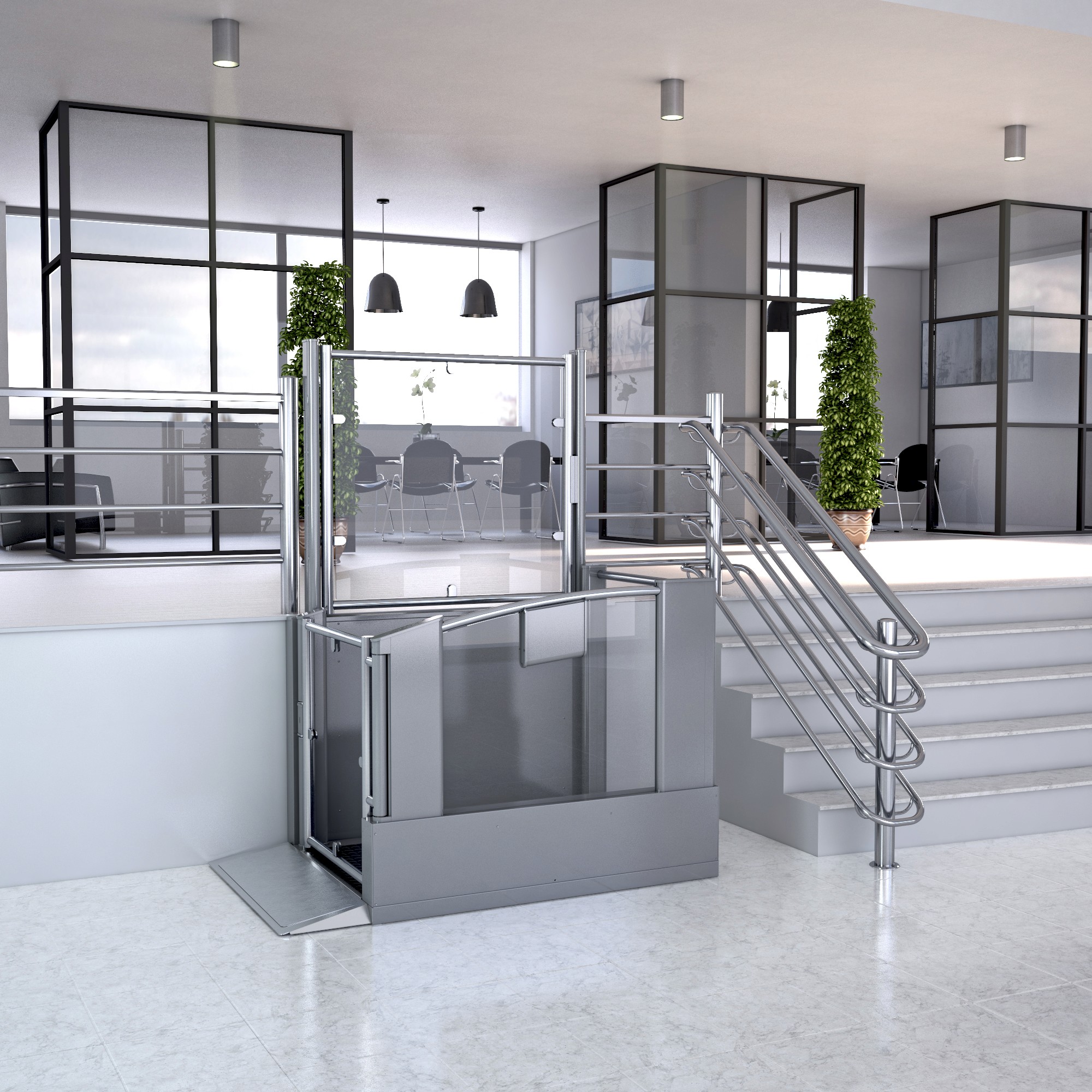
Low-rise open platform lifts are the most commonly specified commercial platform lift type for applications involving level changes of up to three metres — overcoming steps, raised entrances, and small level changes in commercial interiors. They feature an open platform with folding safety arms or barriers on three sides and a gate at the entry point. They are self-supporting and do not require a dedicated lift shaft or pit in most configurations — though a shallow recess or surface-mounted base is typically required at the lower level. Drive systems include rack and pinion, chain drive, and hydraulic. Load capacities typically range from 250kg to 400kg. Key technical parameters to confirm at specification stage include platform dimensions, minimum clear door width (typically 900mm for Part M compliance), handrail height, control station mounting height, and landing accuracy.
Enclosed cabin platform lifts are more substantial lifts with a fully enclosed cabin, sliding or hinged doors, and a more conventional lift aesthetic. They are typically specified where travel distances exceed three metres, where the building design requires an enclosed lift for fire strategy reasons, or where the aesthetic requirements of the project demand a more finished appearance. They require a defined shaft or structural enclosure and a pit at the lower level — pit depths vary by manufacturer but are typically between 50mm and 150mm, significantly less than a conventional passenger lift. Load capacities range from 400kg to 1000kg. Drive systems include screw drive, hydraulic, and traction. BS EN 81-41 applies to enclosed cabin platform lifts with travel up to five metres — beyond this, passenger lift standards under BS EN 81-20 may apply depending on the configuration.
Vertical platform lifts for external use are specified for applications where the level change is external — at a building entrance, between a car park level and a reception level, or between different terrace levels on a commercial site. Specification requirements for external lifts differ significantly from internal lifts — materials must be appropriate for the outdoor environment, drainage must be incorporated into the platform design, control systems must be rated for outdoor use, and in some locations wind loading may be a consideration. Stainless steel or hot-dip galvanised steel is the standard finish for external commercial platform lifts in UK conditions.
Inclined platform lifts are specified for commercial buildings where wheelchair access alongside an existing staircase is required. They travel along a rail fixed to the stair treads and carry a wheelchair user up and down the staircase while the staircase remains accessible to walking users. They are particularly common in listed buildings, places of worship, theatres, and any building where altering or bypassing the staircase is not architecturally or structurally feasible. Key specification considerations include minimum staircase width (typically 1000mm clear for a commercial inclined platform lift), landing dimensions at top and bottom, and whether the staircase geometry requires a straight or curved rail — curved rails are custom manufactured and significantly increase both cost and lead time.
Specification Considerations — Key Parameters for Architects
The following parameters must be confirmed at specification stage for all commercial platform lift projects. Late changes to any of these parameters typically result in programme delays and additional costs.
Travel distance determines the lift type and the applicable standard. Confirm the finished floor to finished floor dimension accurately — nominal dimensions from drawings are frequently inaccurate and on-site measurement before specification is strongly recommended for refurbishment projects.
Platform dimensions must comply with Part M minimum requirements. For vertical platform lifts, Approved Document M specifies a minimum platform size of 900mm x 1400mm for a lift serving a building open to the public. This is a commonly overlooked parameter — some manufacturers offer platforms smaller than this minimum as standard and the specification must explicitly state the required platform dimensions to avoid non-compliant product being supplied.
Pit requirement must be confirmed at the structural design stage. Most commercial platform lifts require a shallow pit at the lower level — even those marketed as no-pit installations typically require a recessed threshold of 10mm to 50mm. The structural implications of creating a pit recess in an existing floor slab must be assessed by the structural engineer. For new build projects, the pit should be designed into the slab from the outset.
Headroom at the upper level must be confirmed against the manufacturer's requirements. Most manufacturers require a minimum headroom of 2200mm to 2400mm above the upper floor level — this must be checked against the building's floor-to-ceiling height at the lift position.
Electrical supply requirements must be confirmed with the mechanical and electrical engineer at the design stage. Most commercial platform lifts require a dedicated single-phase 13A or 16A supply with an isolator located adjacent to the lift. Some larger cabin lifts require a three-phase supply. Battery backup systems require a permanent supply even when the lift is not in use.
Fire strategy implications must be considered for enclosed cabin lifts installed within a building's fire compartmentation. If the lift shaft penetrates a fire compartment boundary, appropriate fire-rated construction and fire doors may be required. This should be confirmed with the building control officer at the pre-application stage.
Acoustic performance is relevant for lifts installed in acoustically sensitive environments — theatres, concert halls, healthcare facilities, and residential buildings above commercial premises. Screw drive systems are generally the quietest — hydraulic systems produce more noise from the power unit and should be specified carefully where acoustic performance is critical.
Part M Compliance — Specific Requirements for Platform Lifts
Approved Document M contains specific requirements for platform lifts in buildings other than dwellings. The following are the key parameters that must be confirmed against the specification.
The minimum platform size for a vertical platform lift in a building open to the public is 900mm x 1400mm. This must accommodate a wheelchair user and allow sufficient space for operation of the controls.
The minimum clear door width is 900mm for a lift serving as the principal means of vertical access for wheelchair users in a commercial building. Where the lift is a secondary means of access a minimum of 800mm may be acceptable — this should be confirmed with the building control body.
Control stations must be positioned at a height accessible to a wheelchair user — typically between 750mm and 1200mm above floor level. The specific height must be confirmed against the manufacturer's standard control station positions.
The lift must achieve level landing accuracy — arriving flush with the floor level at each stop within a tolerance of ±10mm — to allow wheelchair users to board and alight without a step or lip.
Emergency communication must be provided within the lift — either a telephone handset or an audio intercom connected to a continuously staffed location or an alarm monitoring service.
The lift must not be the sole means of evacuation from any floor — a suitable evacuation strategy must be in place for lift users in the event of a fire or other emergency.
LOLER and Ongoing Compliance
The Lifting Operations and Lifting Equipment Regulations 1998 — LOLER — apply to all platform lifts used in commercial settings. Under LOLER, the dutyholder — typically the building owner or the occupier responsible for the lift — must ensure that the lift is thoroughly examined by a competent person at regular intervals. For passenger-carrying platform lifts in commercial use, the examination interval is every six months.
Following each thorough examination the competent examiner must produce a written report confirming the condition of the lift and identifying any defects or deterioration that could create a risk. If a defect is identified that creates an immediate risk the lift must be taken out of service until the defect is rectified.
LOLER examinations are distinct from routine servicing — they are a statutory inspection carried out by a qualified and independent examiner, not a maintenance visit by the lift company. Most commercial buildings require both a LOLER examination contract and a separate planned preventative maintenance contract with a qualified lift engineer.
Architects and project managers should ensure that the tender documentation and employer's requirements for a commercial platform lift project include provision for LOLER compliance from practical completion, and that the building owner or facilities manager is briefed on their ongoing LOLER obligations before handover.
Procurement Considerations for Project Managers
Procuring a commercial platform lift through a main contractor or specialist subcontractor introduces specific risks that project managers should be aware of and mitigate at the tender stage.
Product substitution is one of the most common procurement risks. A tender may be priced on a named product meeting a defined specification, but the contractor or subcontractor substitutes an alternative product of lower quality or specification to improve their margin. The specification should require named product approval and should include a clause requiring written approval for any proposed product substitution before the substituted product is ordered.
Lead times are frequently underestimated for commercial platform lifts — particularly curved inclined platform lifts and large enclosed cabin lifts where custom manufacturing is required. Curved inclined platform lift rails are typically manufactured to order with lead times of twelve to sixteen weeks from order confirmation. This must be factored into the programme at the early design stage — ordering cannot begin until the staircase survey is complete and the geometry confirmed.
Installation sequencing must be planned carefully for lifts that require a pit or shaft structure. The pit recess or shaft must be completed and inspected before the lift manufacturer's installation team arrives on site. If the pit is not ready at the scheduled installation date the lift company will typically charge for the abortive visit and the programme will slip.
Commissioning and handover documentation must include the UKCA or CE declaration of conformity, the operating and maintenance manual, the LOLER initial thorough examination certificate, the Building Regulations completion certificate where applicable, and a training record confirming that the building manager or facilities team has been trained in the operation of the lift and the emergency lowering procedure.
Defects liability for platform lifts in commercial buildings should be a minimum of twelve months from practical completion. The specification should require the installer to remedy any defects arising from workmanship or materials within this period at no additional cost. Some manufacturers offer extended warranties of two to five years on specific components — these should be requested and documented as part of the handover package.
Working with Platform Lift UK — Independent Advice for Building Professionals
Platform Lift UK is an independent matching service. We do not manufacture or install lifts. Our role is to connect architects, project managers, and building professionals with the right vetted lift specialist for the specific requirements of their project — covering lift type, travel distance, building type, location, and programme.
For commercial projects in particular, working with a specialist who has demonstrable experience with your specific lift type and building context is more important than price alone. A specialist commercial inclined platform lift installer and a domestic step lift company are not interchangeable — the experience, technical knowledge, and supply chain relationships required for each are fundamentally different.
Platform Lift UK assesses companies in our network specifically for commercial project experience — including their familiarity with BS EN 81-41, their experience with listed building and conservation area installations, and their track record on projects requiring Building Regulations approval and LOLER certification at handover.
If you are specifying or procuring a commercial platform lift and would like independent advice on lift type selection, specification parameters, or installer procurement, get in touch with Platform Lift UK. Our advice is free, independent, and without obligation.
Frequently Asked Questions — Commercial Platform Lifts
What is the difference between a platform lift and a passenger lift for commercial use? A platform lift travels at a maximum speed of 0.15 metres per second and is governed by BS EN 81-41 or BS EN 81-40. A passenger lift travels at higher speeds and is governed by BS EN 81-20. Platform lifts are appropriate for low to medium use applications and travel distances up to approximately five metres. For high-use applications, travel distances above five metres, or buildings requiring lift speeds above 0.15 metres per second, a passenger lift is more appropriate. The choice between the two should be made at the early design stage in consultation with a lift specialist and the building control body.
Does a commercial platform lift require a structural engineer's input? Yes — in most cases. The structural implications of creating a pit recess, penetrating a floor slab for a through-floor installation, or fixing a rail to historic stair treads in a listed building all require structural engineer assessment. For new build projects, structural input should be incorporated at the RIBA Stage 2 design stage. For refurbishment projects, a structural engineer should assess the existing structure before the lift specification is finalised.
Can a commercial platform lift be installed in a listed building? Yes — platform lifts are one of the most sympathetically received accessibility interventions in listed buildings because they are reversible and do not require permanent structural alterations. Listed building consent is required before any works begin. Early pre-application engagement with the local planning authority's conservation officer is strongly recommended. The choice of lift type and finish should be sensitive to the character of the listed building — open platform lifts with minimal visual impact are generally preferred over fully enclosed cabin lifts in heritage settings.
What is the typical programme for a commercial platform lift installation? For a straight vertical platform lift or open platform lift — four to eight weeks from order to installation, with installation typically completing in one to two days. For a curved inclined platform lift — twelve to sixteen weeks from survey to installation due to the custom rail manufacturing requirement. For a large enclosed cabin lift with a new shaft — programme duration depends heavily on the building works required to create the shaft structure and should be agreed with the installer at the tender stage.
Who is responsible for LOLER compliance after handover? The dutyholder under LOLER is the person who has control of the lift — typically the building owner or the occupier responsible for the premises. For leasehold commercial buildings, the lease terms will determine whether LOLER responsibility sits with the landlord or the tenant. This should be clarified at the legal stage of a building acquisition or lease negotiation. Platform Lift UK can connect building owners and facilities managers with qualified LOLER examination providers covering their area.
How do I specify a commercial platform lift correctly to avoid product substitution? The specification should name the required product or an approved equivalent and include the key technical parameters — platform dimensions, door width, travel distance, load capacity, drive system, finish, and applicable standard. A clause requiring written approval for any proposed substitution should be included. Pre-order approval of the proposed product and a review of the UKCA conformity documentation before the product is ordered provides additional protection against non-compliant substitution.
CLOSING SECTION
Platform Lift UK is an independent matching and referral service for homeowners and building professionals across the UK. We do not install lifts. Our role is to connect architects, project managers, building owners, and facilities managers with vetted lift specialists who have the right experience for their specific project.
For commercial platform lift projects — whether new build, refurbishment, listed building, or change of use — get in touch with Platform Lift UK for free independent advice on lift type selection, specification parameters, and installer procurement. We will assess your project requirements and introduce you to the right specialist from our vetted network at no cost and with no obligation to proceed.
Incline Platform Lift Link
